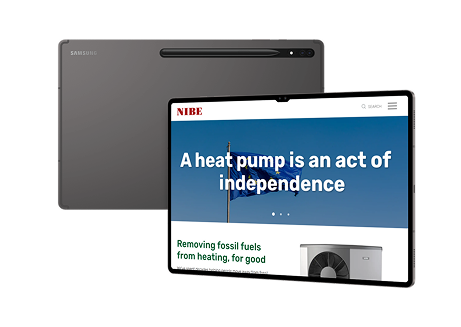
FiftyFive Technologies developed a full-cycle ecosystem of IoT, mobile, and web applications that enable remote heating control, streamlined maintenance for technicians, and reliable real-time performance across more than 100,000 connected devices — built to scale across international markets.
The client is a Sweden-based global leader in heating and HVAC IoT solutions, serving homeowners, professionals, and enterprises with advanced energy-efficient technologies across multiple international markets. FiftyFive Technologies partnered with the client to deliver a full-cycle digital ecosystem of mobile and web applications for homeowners, technicians, and administrators — spanning custom software development, IoT integration, cloud deployment, and automated QA, delivered by a dedicated team working in Agile sprints.
The Need
Challenges
Delivering a unified heating and HVAC platform across iOS, Android, and the web — while connecting and scaling more than 100,000 devices — meant solving both demanding performance requirements and complex data and integration hurdles.
Maintaining consistent cross-platform performance across iOS, Android, and web applications.
Presenting complex heating and IoT data in formats that homeowners, technicians, and administrators could easily understand and act on.
Testing across multiple device brands with limited access to physical hardware.
Scaling the platform to support 100,000+ connected devices with reliable real-time updates.
Integrating with third-party APIs and smart home platforms without breaking the unified experience.
Reducing manual testing effort while maintaining a fast, predictable release velocity.
Our Approach
Solution
FiftyFive built a full-cycle digital ecosystem connecting devices, applications, and the cloud into one reliable platform. The work covered native mobile apps for end users and field technicians, web portals for service partners and administrators, a scalable backend, cloud infrastructure on Azure, and an automated QA pipeline. A dedicated team of mobile developers, backend engineers, QA automation specialists, and cloud architects delivered the system in Agile sprints, prioritizing scalability, reliability, and global usability throughout.
Cross-platform applications
Built connected mobile and web applications for homeowners, technicians, service partners, and administrators.
Native mobile apps built with Swift for iOS and Kotlin for Android for homeowners and technicians.
Web portals built with React and Redux for service partners and administrators.
Connected experiences enabled remote heating control and streamlined field-service workflows.
Scalable backend & cloud infrastructure
Connected devices, backend services, and Azure infrastructure to process reliable real-time data at global scale.
Backend services implemented with .NET Core, Node.js, and C# for scalability.
Azure IoT Hub and Azure Service Bus connected devices and transported real-time data.
Cosmos DB, PostgreSQL, and Redis Cache supported high-volume platform data.
Automated QA & CI/CD
Automated testing and delivery workflows maintained quality while supporting a faster, more predictable release velocity.
Automated UI testing implemented with Java, Appium, and TestNG.
CI/CD pipelines integrated with GitHub Actions to maintain release velocity.
Performance validation reduced manual testing effort across multiple device brands.
Technology
Tech Stack
Web / Frontend
ReactRedux
Cloud & IoT
Azure IoT HubAzure Service BusCosmos DBPostgreSQLRedis Cache
Backend
.NET CoreNode.jsC#
DevOps / CI-CD
GitHub Actions
Mobile
SwiftKotlin
QA & Testing
JavaAppiumTestNG
Experts
Team
1
Project Lead
3
Front-End Developer
3
Back-End Developer
3
Quality Analyst
1
DevOps Engineer
The Impact
Results
Project Duration2025 - ongoing
The platform now gives homeowners, technicians, and administrators reliable, real-time control over heating and HVAC systems at global scale — delivering measurable cost savings, faster field operations, and higher customer satisfaction across more than 10 countries.
40% lower manual testing costs
Automated UI testing with Java, Appium, and TestNG — integrated into CI/CD via GitHub Actions — cut manual testing effort and the associated costs by 40%, while keeping release quality high.
30% faster installation & commissioning
Technicians completed installation and commissioning 30% faster, reducing time on site and improving field productivity.
2 weeks faster release cycles per sprint
CI/CD automation accelerated release cycles by two weeks per sprint, letting the client ship improvements to users more frequently.
100,000+ devices at <2s latency
The architecture scaled to support 100,000+ connected IoT devices with sub-2-second latency, ensuring reliable real-time monitoring and control. Combined with remote monitoring and a multilingual rollout across 10+ countries, this drove higher adoption and customer satisfaction — positioning the client for continued global growth.
Support
FAQs
IoT in HVAC connects heating, ventilation, and air-conditioning equipment with sensors, cloud platforms, mobile apps, and web dashboards. It allows homeowners, technicians, and facility teams to monitor system performance, control temperatures remotely, receive fault alerts, analyse energy usage, and manage connected heating equipment from a central digital platform.
IoT can improve HVAC energy efficiency by using real-time device data, schedules, temperature settings, and performance insights to optimise heating and cooling operations. Remote monitoring also helps identify unnecessary energy consumption, equipment faults, and inefficient settings, allowing businesses and homeowners to reduce utility costs while maintaining comfortable indoor conditions.
Remote HVAC monitoring uses connected sensors and cloud-based software to send equipment data to mobile apps or web portals. Users can view temperatures, system status, alarms, and performance information in real time. Authorised users can also adjust settings, troubleshoot issues, and manage heating systems without visiting the physical location.
HVAC monitoring and control software should include real-time device status, remote temperature control, scheduling, energy insights, alerts, user permissions, maintenance records, and performance dashboards. Advanced platforms may also provide technician workflows, multilingual interfaces, smart home integrations, predictive maintenance capabilities, and centralised management for thousands of connected heating devices.
IoT supports predictive HVAC maintenance by continuously collecting data such as temperature, pressure, operating cycles, alarms, and equipment performance. Software can identify unusual behaviour before a major failure occurs, allowing service teams to schedule maintenance earlier, reduce unexpected downtime, avoid costly repairs, and extend the operational life of heating equipment.
HVAC manufacturers can connect legacy equipment to cloud applications by adding compatible gateways, controllers, communication modules, or APIs that transmit device data securely. A custom IoT integration layer can convert existing protocols into cloud-compatible formats, enabling remote monitoring, mobile control, diagnostics, and digital services without replacing the entire installed hardware base.
A homeowner HVAC app focuses on simple controls such as temperature adjustment, schedules, energy usage, and fault notifications. A technician app supports professional tasks including installation, commissioning, diagnostics, configuration, maintenance records, and multi-device management. Both applications may use the same cloud platform but provide different interfaces and access permissions.
HVAC software can integrate with smart home platforms, building systems, and third-party services through secure APIs and standard communication protocols. These integrations allow users to connect heating controls with automation platforms, energy management tools, service systems, or voice assistants while maintaining consistent data, authentication, commands, and device status across applications.
Cloud-connected HVAC systems can be secure when protection is implemented across devices, applications, APIs, and cloud infrastructure. Important measures include encrypted communication, secure device identities, role-based access, strong authentication, audit logs, protected credentials, vulnerability testing, and regular software updates to prevent unauthorised control or exposure of operational data.
An HVAC IoT platform can scale by using cloud-based device management, distributed databases, message queues, caching, automated deployment, and independently scalable backend services. Multilingual interfaces, regional configurations, reliable connectivity handling, and performance testing are also important for supporting thousands of devices, different user groups, and international market requirements.
The cost of developing a custom HVAC IoT platform depends on the number of mobile and web applications, supported device types, integrations, security requirements, cloud architecture, languages, and testing scope. A proof of concept is usually less expensive, while a global platform with real-time connectivity and multiple user applications requires phased investment.
Choose an HVAC IoT software development company with proven experience in mobile apps, web platforms, backend engineering, cloud infrastructure, device connectivity, automated testing, and DevOps. The partner should understand real-time performance, security, scalability, hardware integration, technician workflows, and international rollout requirements while offering flexible team and long-term support models.
We use cookies to personalise content and ads, to provide social media
features and to analyse our traffic. We also share information about
your use of our site with our social media, advertising and analytics
partners who may combine it with other information that you’ve provided
to them or that they’ve collected from your use of their services.
Necessary cookies help make the website usable. Analytics cookies help
us understand how visitors interact with the website. Marketing
cookies may be used to deliver relevant ads and measure campaign
performance.
Necessary cookies
Required for core website functionality. These cannot be
disabled.
Analytics cookies
Helps us measure traffic and improve website performance.
Marketing cookies
Used for advertising, remarketing, and campaign tracking.