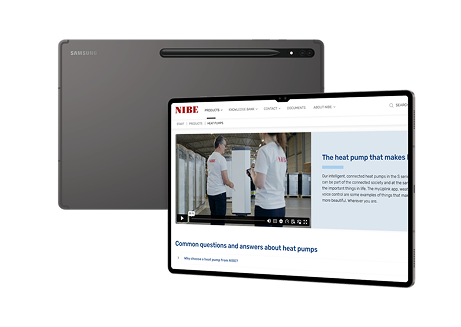

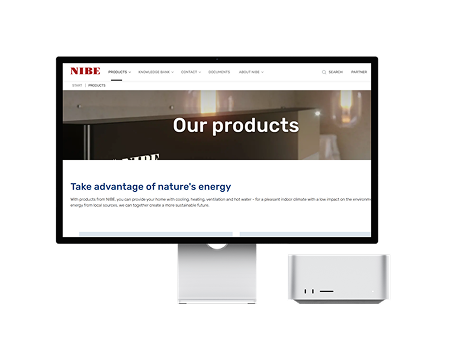
NIBE needed a digital sales platform that could grow with rising customer demand without growing its operational burden. FiftyFive designed, built, and deployed the customer portal from the ground up — pairing custom software development with DevOps automation to deliver faster releases, stable high-traffic operations, and the capacity to handle higher transaction volumes.
NIBE is a Sweden-based aftermarket spare parts company that needed a scalable digital sales platform backed by automated infrastructure, real-time monitoring, and high system availability to support expanding customer demand. FiftyFive Technologies was engaged to design, build, and deploy the customer portal from the ground up — delivering full-cycle custom software development and DevOps engineering. A dedicated team of cloud engineers, backend and frontend developers, and DevOps specialists ensured the platform was scalable, automated, and production-ready, with a clear focus on enabling business growth while minimizing manual operations and infrastructure costs.
The Challenge
The Challenges That Started It All
NIBE’s portal had to scale reliably under growing, often spiky customer demand while keeping manual infrastructure work to a minimum. Meeting that goal meant solving several interlocking engineering challenges at once.
Designing a scalable, fault-tolerant deployment foundation. The portal needed infrastructure that could absorb traffic spikes and stay available without manual intervention.
Automating recurring operational jobs. Daily operational tasks were handled manually, creating overhead and room for error.
Containerizing frontend and backend as deployable services to support portable, repeatable, and environment-agnostic deployments.
Routing traffic securely and efficiently with real-time visibility so performance issues could be identified before affecting users.
Cutting deployment time through CI/CD automation to shorten the path from code to production.
The Solution
Solutions We Delivered
FiftyFive built and deployed NIBE’s customer portal as a fully automated, production-ready platform on Azure. The architecture containerizes both the frontend and backend, deploys them through automated CI/CD pipelines, and orchestrates them on Kubernetes with secure, monitored traffic routing. Recurring operational jobs were automated to remove manual handling, and real-time monitoring was wired into the application gateway for continuous performance visibility. The result is infrastructure that scales with demand while keeping operational effort low.
Containerized application delivery
Packaged the frontend and backend as portable, consistent services for repeatable deployments across environments.
Built Dockerfiles and Docker-Compose configurations to containerize both frontend and backend services.
Created consistent application packages that support repeatable, environment-agnostic deployments.
Established a dependable foundation for scalable application delivery.
Automated CI/CD pipelines
Automated the release process to make deployments faster, repeatable, and less dependent on manual operational steps.
Implemented multi-stage CI/CD pipelines in Azure DevOps for automated, repeatable deployments.
Reduced the manual effort and time required to move code into production.
Standardized release workflows across the portal’s application services.
Kubernetes orchestration, provisioning and monitoring
Combined Kubernetes orchestration, Helm-based provisioning, secure traffic routing, operational scheduling, and real-time monitoring into one production-ready foundation.
Created Kubernetes manifests for deployments, services, and path-based Ingress routing.
Configured the Application Gateway Ingress Controller for secure and efficient request handling.
Provisioned PostgreSQL, AGIC, and Cert-manager through Helm within Azure pipelines.
Automated daily scheduled jobs to eliminate manual operational handling.
Integrated real-time traffic monitoring on the application gateway for proactive performance management.
Project LeadDevOps Lead statement required
No delivery lead or project lead quote was included in the source material. Add a short, approved statement attributed to the DevOps Lead before publishing.
Tech Stack
Tools That Powered the Build
Containerization
DockerDocker-Compose
Database
PostgreSQL
CI/CD
Azure DevOpsMulti-stage Pipelines
Networking & Security
AGICPath-based RouteTraffic Monitoring
Provisioning
HelmCert-manager
Orchestration
KubernetesDeploymentsServicesIngress
3 People
Team structure
2
Front-End Developer
1
Back-End Developer
The Outcome
Results That Speak Clearly
Client Since2023
NIBE gained a fully automated, production-ready portal that scales with demand while requiring far less manual operational work. The platform is live and supporting real customer transactions, directly contributing to increased sales and stronger customer trust.
70% faster deployments
Multi-stage CI/CD pipelines in Azure DevOps replaced manual deployment steps, cutting deployment time by 70% and shortening the path from code to production.
99.9% uptime
Kubernetes orchestration improved system availability to 99.9%, keeping operations stable even during high-traffic periods.
40% lower overhead
Automated scheduling eliminated manual job handling and scalable infrastructure reduced operational overhead by 40%.
Higher transaction capacity
Scalable infrastructure and real-time traffic monitoring enabled higher transaction volumes and proactive performance management.
An aftermarket spare parts sales portal is a digital platform where customers, dealers, or distributors can search for replacement parts, view product information, check availability, and place orders online. It helps manufacturers and spare parts businesses simplify purchasing, reduce manual sales processes, and provide customers with faster access to the correct components.
A spare parts e-commerce portal should include an advanced product catalogue, part-number search, customer accounts, pricing, inventory visibility, order management, secure payments, and delivery tracking. B2B platforms may also need customer-specific pricing, bulk ordering, role-based access, ERP integration, automated workflows, and infrastructure capable of supporting high transaction volumes.
A digital sales portal improves spare parts sales by making products easier to find and purchase without relying on manual quotations, phone calls, or email-based orders. It gives customers continuous access to product information and ordering tools while helping businesses process transactions faster, reduce administrative work, and support a growing customer base.
Custom portal development allows a spare parts business to build workflows around its catalogue structure, pricing model, customer types, integrations, and operational processes. Unlike a standard e-commerce template, a custom spare parts portal can support complex part searches, B2B ordering rules, higher transaction volumes, and future functionality without restrictive platform limitations.
A scalable B2B spare parts portal is built using modular application services, containerization, cloud infrastructure, automated deployments, traffic management, and continuous monitoring. Technologies such as Docker, Kubernetes, and CI/CD pipelines allow the platform to handle increasing users and transactions while keeping releases consistent and reducing the need for manual infrastructure management.
A spare parts portal can handle sudden traffic spikes through scalable cloud infrastructure, container orchestration, load distribution, and real-time monitoring. Kubernetes can increase application capacity, restart failed services, and distribute workloads, while traffic-routing tools direct requests efficiently. This helps maintain stable performance during promotions, seasonal demand, or increased customer activity.
DevOps automation improves an e-commerce portal by making software builds, testing, deployments, infrastructure updates, and scheduled operations faster and more consistent. Automated CI/CD pipelines reduce manual errors and shorten release cycles, while monitoring and orchestration tools improve system availability. This enables businesses to launch improvements without creating unnecessary operational disruption.
CI/CD pipelines automate the process of building, testing, and deploying software updates. For a custom sales portal, this means new features, bug fixes, and security improvements can reach production faster and with fewer manual steps. A well-designed CI/CD process also creates repeatable deployments and reduces the risk of environment-related release failures.
Businesses can reduce portal management costs by automating deployments, recurring jobs, infrastructure provisioning, monitoring, and application recovery. Cloud-based orchestration reduces repetitive maintenance, while scheduled workflows replace manual tasks. In this type of project, automation and scalable infrastructure can significantly lower operational overhead while allowing a small team to manage a growing platform.
A cloud-based spare parts portal can be highly secure when it uses encrypted connections, managed certificates, controlled traffic routing, access policies, secure application gateways, and continuous monitoring. Kubernetes Ingress, Cert-manager, and cloud networking services can help protect customer requests while ensuring traffic reaches the correct frontend, backend, or database services securely.
The cost of building a custom spare parts portal depends on catalogue size, search complexity, customer roles, ordering workflows, payment requirements, integrations, security, and expected traffic. An enterprise platform with cloud infrastructure, Kubernetes, CI/CD automation, monitoring, and ERP connectivity will cost more than a basic portal. A discovery phase is required for a reliable estimate.
A basic spare parts portal may take a few months to design and develop, while a complex enterprise platform is usually delivered in phases. Timelines depend on product data, integrations, customer workflows, cloud architecture, security requirements, and testing. Ongoing development may continue as transaction volumes, markets, and business requirements grow.
Businesses should choose a spare parts portal development company with experience in custom software, B2B e-commerce, cloud engineering, DevOps, integrations, security, and production support. The provider should be able to build both frontend and backend systems, automate deployments, support high availability, monitor traffic, and scale the engineering team when required.
A business should hire DevOps engineers when its sales platform requires frequent deployments, high availability, automated infrastructure, traffic monitoring, cloud migration, or Kubernetes management. DevOps specialists help create reliable CI/CD pipelines, secure routing, repeatable environments, and operational automation, allowing development teams to release faster while reducing downtime and manual maintenance.
We use cookies to personalise content and ads, to provide social media
features and to analyse our traffic. We also share information about
your use of our site with our social media, advertising and analytics
partners who may combine it with other information that you’ve provided
to them or that they’ve collected from your use of their services.
Necessary cookies help make the website usable. Analytics cookies help
us understand how visitors interact with the website. Marketing
cookies may be used to deliver relevant ads and measure campaign
performance.
Necessary cookies
Required for core website functionality. These cannot be
disabled.
Analytics cookies
Helps us measure traffic and improve website performance.
Marketing cookies
Used for advertising, remarketing, and campaign tracking.