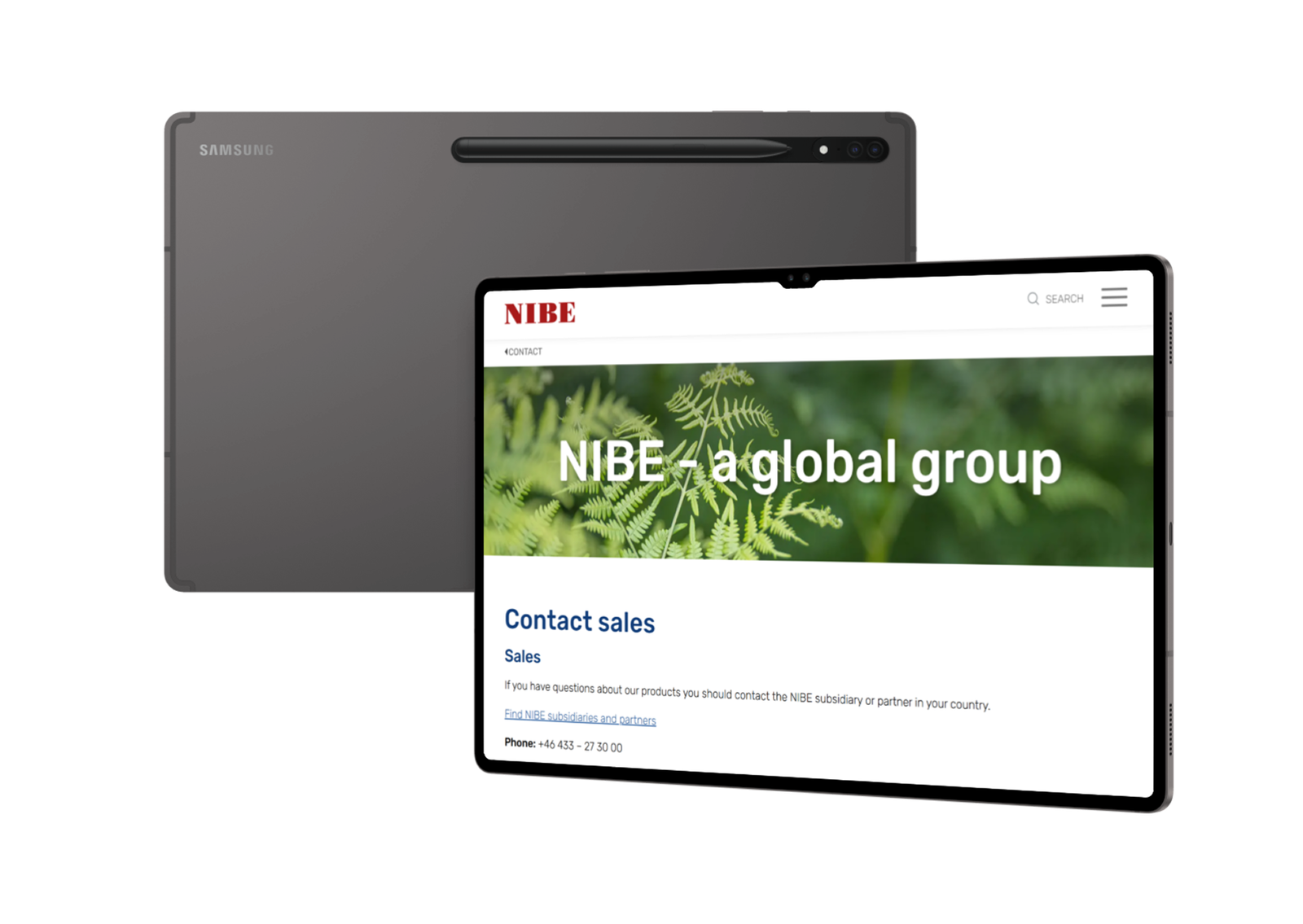
FiftyFive built & validated a unified Customer Portal that replaced manual, phone-based workflows with a single production-grade platform. It centralized spare parts, documentation, & troubleshooting, streamlined operations, & gave the client a scalable foundation for multi-country European expansion.
The client is a Sweden-based B2B spare parts and heat pump manufacturer serving multiple European markets. Their operations spanned spare parts, technical documentation, troubleshooting workflows, and multi-country partner coordination — but relied on manual, phone-based ordering and a set of fragmented legacy tools. They needed a single, scalable digital platform to centralize these workflows and support high-volume service operations across regions.
They partnered with FiftyFive Technologies as their full-cycle engineering provider, covering architecture, development, DevOps, automation, and performance validation. A dedicated cross-functional team delivered the portal using a microservices-driven approach to ensure reliability, scalability, and localization accuracy across markets — building a production-grade platform while establishing an automation framework to accelerate global rollout.
The Need
Challenges
Replacing manual, phone-dependent ordering with a unified portal that could scale across multiple European markets meant solving both operational fragmentation and demanding technical requirements at the same time.
Manual ordering flows dependent on phone coordination, creating bottlenecks and slowing high-volume service operations.
No centralized repository for spare parts, documentation, or software files, leaving partners without a single source of truth.
Fragmented legacy tools that required separate installations and manual updates, increasing maintenance overhead and inconsistency.
Lack of automated error reporting and operational monitoring, making issues hard to detect and resolve proactively.
Multi-country workflow inconsistencies and localization differences, where language and routing varied by region.
Microservices interactions that behaved differently across regional configurations, raising reliability and testing complexity.
High-traffic performance risks as the platform expanded into new markets and faced traffic spikes.
Our Approach
Solution
FiftyFive delivered a production-grade, microservices-based Customer Portal designed for reliability, scalability, and accurate localization across regions. The platform replaced manual ordering and scattered legacy tools with a single hub for spare parts, documentation, and service workflows. Alongside the product, the team built an automation and QA framework to keep releases fast and safe during multi-country rollout, and added monitoring and analytics so operations could be observed and improved continuously. The result is a foundation engineered to handle high traffic and regional variation without sacrificing stability.
Microservices-based portal architecture
Built a microservices-based Customer Portal with a modern frontend and structured data layer to replace fragmented legacy tools.
Built a microservices-based Customer Portal with a React.js frontend.
Developed GraphQL APIs integrated with PostgreSQL for structured product data.
Scalable cloud infrastructure & DevOps
Deployed scalable infrastructure and automated pipelines to support continuous delivery across environments.
Deployed AKS clusters using GitHub Actions, ArgoCD, and Headlamp workflows.
Automated QA pipelines to accelerate continuous deployment across environments.
Automated monitoring & analytics
Implemented proactive error reporting and usage analytics to keep the platform observable and continuously improving.
Implemented cron-based error reporting with Microsoft Teams webhook alerts.
Integrated Microsoft Clarity for partner usage analytics and behavior tracking.
Multi-country QA automation
Created comprehensive test automation to validate localization and routing accuracy across every supported market.
Created Cypress automation suites achieving 90% test coverage across countries.
Applied parameterized, region-specific test execution to validate language and routing.
Performance & load validation
Validated that the platform could handle traffic spikes as it expanded into new European markets.
Performed load and stress testing using Artillery to ensure high-traffic readiness across new markets.
Technology
Tech Stack
Frontend
Next.js
API Layer
GraphQL
Database
MongoDB
Cloud & CI/CD
KubernetesAzure
Monitoring & Analytics
Cron Error Reporting WebhooksMS Clarity
Testing
CypressArtillery
Experts
Team
A cross-functional team of 8 delivered end-to-end — from architecture and development through DevOps, QA automation, and performance validation.
2
Project Leads
2
Front-End Developer
2
Back-End Developer
1
Quality Analyst
1
DevOps Engineer
The Impact
Results
Project Duration2022 - ongoing
The unified Customer Portal gave the client a single, scalable platform for high-volume service operations across multiple European markets. By replacing phone-based coordination and fragmented tools, it accelerated partner adoption while the automation and performance framework kept releases fast, safe, and ready for traffic spikes during expansion.
60% partner onboarding
Exceeded the 40% target in year one. Automated workflows reduced manual support load, improved spare parts discovery, and removed the dependency on phone-based coordination.
60%+ less manual testing
QA automation enabled faster, safer releases during multi-country expansion, cutting manual testing effort by more than 60%.
90% test coverage
Region-specific, parameterized test execution validated language and routing accuracy across all supported markets.
High-traffic ready
Load and stress testing confirmed the portal could handle traffic spikes across new markets, giving the client a reliable foundation for long-term growth.
Support
FAQs
A B2B customer portal is a secure digital platform that gives dealers, distributors, installers, and service partners access to spare parts, product documents, software files, troubleshooting resources, and support workflows. It helps manufacturers centralize partner operations, reduce manual coordination, and deliver consistent self-service experiences across multiple markets.
An online spare-parts ordering portal allows authorized partners to search product catalogues, identify compatible components, access technical information, and submit orders or service requests digitally. It replaces phone calls, emails, and fragmented tools with a structured workflow that improves order accuracy, response times, product discovery, and operational visibility.
A self-service dealer portal reduces dependence on customer support by giving partners direct access to ordering, documentation, downloads, troubleshooting, and account-specific information. Manufacturers benefit from fewer manual enquiries, faster service delivery, improved partner satisfaction, consistent product information, and better scalability as the distributor or service network grows.
An aftermarket service portal should include spare-parts search, product documentation, software downloads, troubleshooting workflows, order management, partner accounts, regional content, automated alerts, and usage analytics. It should also support secure access, integration with existing business systems, mobile-responsive design, and scalable infrastructure for increasing products, users, and markets.
Manufacturers can replace phone-based ordering by creating a digital spare-parts portal that centralizes product data, documentation, order requests, and partner communication. A phased rollout allows existing processes and systems to remain operational while dealers gradually move to self-service workflows, reducing support workload and improving ordering speed and accuracy.
Manufacturers should choose custom customer portal development when standard software cannot support their product structures, legacy integrations, regional workflows, localization needs, or partner processes. Off-the-shelf platforms may suit simpler operations, while a custom solution provides greater flexibility, control, scalability, and alignment with long-term aftermarket service requirements.
Manufacturing customer portals integrate with ERP, CRM, inventory, and product information systems through secure APIs and middleware. These integrations allow the portal to display current product data, stock information, documents, customer accounts, and order status. A centralized integration layer also reduces duplication and keeps information consistent across systems.
A multilingual customer portal requires configurable language content, country-specific product data, regional routing, localized workflows, and automated testing for each market. The platform should separate regional settings from core functionality so new countries can be added efficiently without rebuilding the entire portal or creating inconsistent partner experiences.
A scalable B2B customer portal uses modular architecture, cloud infrastructure, automated deployment, performance monitoring, and load testing. Microservices and Kubernetes can help individual services scale independently during traffic spikes. The platform should also be tested with realistic user volumes, product searches, downloads, and ordering workflows before entering new markets.
A secure dealer portal should use authenticated accounts, role-based access, encrypted connections, protected APIs, audit logs, secure cloud environments, and regular vulnerability testing. Access permissions should ensure that users only see relevant products, documents, and regional information, while monitoring helps detect unusual activity and operational issues early.
The cost of custom B2B customer portal development depends on features, integrations, product-data complexity, user roles, localization, security, cloud infrastructure, and migration requirements. A basic portal costs less than a multi-country platform with spare-parts ordering, automated testing, analytics, ERP integration, and high-traffic performance requirements.
A manufacturing customer portal can take several months to design, develop, integrate, test, and launch, depending on its scope. Timelines increase when the platform requires legacy-system integration, multilingual support, complex product catalogues, data migration, automation, and regional rollouts. A phased launch usually reduces risk and accelerates partner adoption.
Choose a customer portal development company with experience in custom software, cloud engineering, system integration, DevOps, QA automation, and performance testing. The provider should understand manufacturing and aftermarket workflows, offer a cross-functional engineering team, and demonstrate the ability to support long-term maintenance, scaling, and multi-country expansion.
A multi-country customer portal requires functional, integration, localization, security, performance, and regression testing. Automated tests should validate ordering, product search, language, routing, authentication, and regional configurations. Load and stress testing should also confirm that the platform can remain stable during partner growth, new-market launches, and traffic spikes.
We use cookies to personalise content and ads, to provide social media
features and to analyse our traffic. We also share information about
your use of our site with our social media, advertising and analytics
partners who may combine it with other information that you’ve provided
to them or that they’ve collected from your use of their services.
Necessary cookies help make the website usable. Analytics cookies help
us understand how visitors interact with the website. Marketing
cookies may be used to deliver relevant ads and measure campaign
performance.
Necessary cookies
Required for core website functionality. These cannot be
disabled.
Analytics cookies
Helps us measure traffic and improve website performance.
Marketing cookies
Used for advertising, remarketing, and campaign tracking.